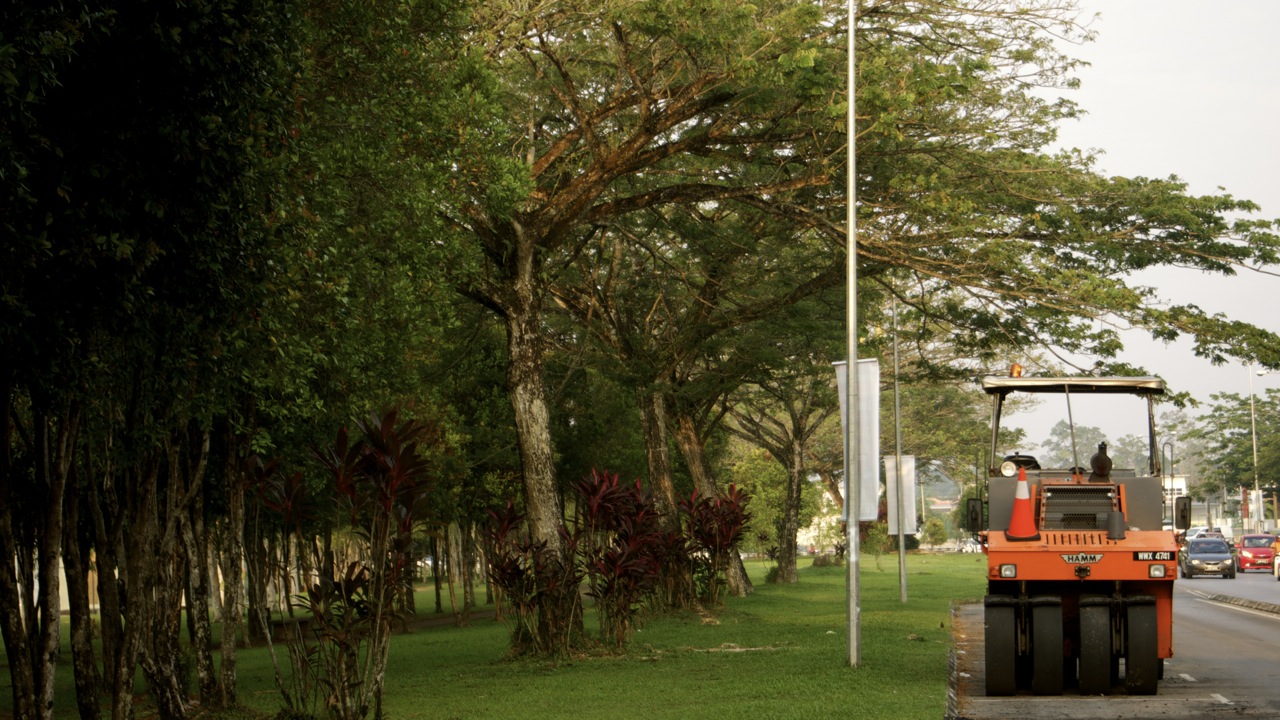
Big Yellow Taxi


Every five years, our highways, main trunk or artery roads, and if you're lucky, collector roads that run in front of your house, are re-sealed in order to please the hearts and cars of thousands of motorists in Sarawak. This is not a unique culture in Sarawak per se, but it is a "cultural" norm throughout Malaysia every time election season draws near. 

It makes me wonder, for the same amount spent on fixing roads, that did not really need any major repair works in the first place, could the money be spent on some much needed public amenities such as community halls, or better parks, or perhaps better landscaping along the roads. 

I took this photograph during my morning rush. Seeing how this roller parked next to the park reminded me of Joni Mitchell's "Big Yellow Taxi"and how relevant that song is still today, I played with the idea of this photo opportunity for a couple of days before I decided to take this photo while they were still doing road works in that area. Luckily, that morning's traffic was quite smooth so I had some time to stop by and capture this scene.

As much as I would like to have smoother roads to drive on, I do think that we should perhaps consider the long term programme of planting shadier trees along the road as these trees take much longer time to grow compared to the life cycle of the roads. By providing a much more calming and scenic motoring experience, perhaps the number of accidents may decrease as motorists begin to slow down and appreciate nature. Also, it may reduce the stress levels among motorists, which in turn reduces the amount of road rage. 

Camera: Olympus OMD E-M10
Lens: M.Zuiko Digital ED 14-42mm f3.5-5.6

Comments

Popular posts from this blog

Extinction or evolution?

The Kenyalang Park mixed development is one of the oldest modern residential and commercial area in Kuching. The development consist of single storey and double storey low-cost houses with a centralized commercial hub, which comprise of shophouses, a market, a cinema/theatre and an office block. A new wet market was added to the area while a new block of shophouses was tucked in the back of the old shophouses.  The name Kenyalang is taken from the local name for the Hornbill bird, which is also the official bird of the state of Sarawak. Sarawak is also known as "Bumi Kenyalang" or "Land of the Hornbills". Just like the bird, which has deep roots in the local Dayak culture, this area has also a deep relationship with Kuchingites and the history of the city. This area is becoming a jewel to artists and photographers as this is the few places where traditional businesses still thrive. The juxtaposition of 60s modern architecture with a mix of traditional and...

Too soft and fluffy

Last weekend was the launch of the inaugural Sarawak Hobby Fest 2015. The two days event was held at Kuching Sentral and saw a huge turnout of collectors, cosplayers, yo-yo players, and even a very talented local artist. The crowd response was also overwhelming despite not having any advertisements in the physical format i.e. banners and newspapers. I could not make it on the first day due to heavy overlapping schedule on that Saturday, and sadly missed out on the cosplays. I was looking forward to it so much as I wanted to hone my portrait photography skills. Nevertheless, I was there on Sunday and had fun looking at and photographing the amazing line-up of Gundams, Transformers, dolls and other collectibles that were on display there. It was fun to be able to use the 50mm lens on the Canon 60D again. I've missed it very much as I am continually trying to get myself used to my new Olympus OMD E-M10. I really like to 50mm format for its tight framing and shallow dept...

Reverse Ruin

I love exploring abandoned buildings, especially old derelict houses.  Stepping into them is like walking through a time portal. The furniture, books and personal belongings that lie covered in dust, half eaten by insects, and strewn across the floor as if a tornado ripped through the house fuels the imagination of what it felt like living in that house during its most prosperous era.  Those very same items also left an unanswered question to explorers, and perhaps the same question asked by the house, towards its forgotten owners - why did they abandoned the place? Properties are always considered as investments and a property owner would not abandon such huge investments without making a profit out of it first. There a a many reasons why buildings are abandoned, but to make a relevant connection to the local environment, it could be narrowed down to a few reasons such as, eviction due to bankruptcy, death of the remaining occupant, and migration of the occupants t...